Crossing the Aubrac plateau in Lozère via the Via Podiensis, the Way of St. James invites you on an adventure that is both physical and spiritual. Between magnificent landscapes, authentic villages, and a rich heritage, this historic route allows you to follow in the footsteps of pilgrims and experience a unique journey, combining discovery, rejuvenation, and introspection.
According to legend, after the death of Christ, the apostle Saint James the Greater was tasked with evangelizing Spain. Unable to fulfill his mission, he returned to Galilee where he was beheaded in 44 AD. His body, placed in a boat, is said to have drifted to Galicia, where he was buried.
In 813, the hermit Pelagius received a vision: to follow a star to the apostle’s tomb. The place was named Campus Stellae (“field of the star”), which later became Santiago de Compostela. King Alfonso II the Chaste had a church built there, and the site quickly became a place of pilgrimage for travelers from Spain and then from across Europe.
In 951, Godescalc, Bishop of Le Puy-en-Velay, was the first Frenchman to walk the Via Podiensis, passing through Nasbinals to reach Santiago de Compostela. Since then, thousands of pilgrims, known as “Jacquets,” have walked this route every year. They recognize each other by their staff (large walking stick) and the scallop shell, an emblematic symbol of the pilgrimage.
To prepare for your adventure on the Camino de Santiago, two essential resources are available at our three tourist offices:
The guidebook (Ref. 651), which details the stages and routes, and
the Miam Miam Dodo, ideal for planning your accommodations and breaks.
To find hiking equipment once you arrive, you can visit the following stores:
Aubrac Rando in Aumont-Aubrac
Astro Marché in Nasbinals
Several water fountains are available along the route:
In Aumont-Aubrac:
Fountain at the Tourist Office
Public restrooms: to the left of the town hall bar, in the public garden, under the church
In Nasbinals:
Public restrooms at Place du Foirail
Other water fountains on the GR:
La Chaze-de-Peyre
Lasbros
Finieyrols
Rieutort d’Aubrac
Montgros
May and September are the most pleasant months for hiking. Temperatures are mild and nature is lush and green. However, note that May is also the busiest month! Summer remains ideal for hiking, with cool, sunny days on the plateau.
On the other hand, winter is not recommended. Snow and strong winds, known as “la burle,” can make hiking dangerous, especially at higher altitudes. Furthermore, snowfall is frequent, sometimes even in spring, and can disorient hikers.
Remember: regardless of the season, nights remain cool above 1,000 meters.
In Aumont-Aubrac:
Parking above the SNCF train station: long-term, free, unsupervised
Municipal campsite: garage closed from the beginning of May to the end of September, €2.25/night – Tel: +33 6 86 68 84 16
Aubrac Auto Passion Garage: paid, supervised parking – Tel: +33 4 66 94 09 14
GERVAIS L&D Garage: paid, supervised parking – Tel: +33 4 66 42 80 17
In Nasbinals:
Parking at the medical center (unpaved section)
Yes! Several companies offer luggage transport along the GR65. You can have your bag transported to your chosen stop, or even skip a stage if you’re tired.
Important: the shuttles run on a fixed schedule and infrequently. It is therefore essential to book in advance to guarantee service.
Bivouacking (pitching your tent for a single night, from sunset to sunrise) is permitted on the Aubrac plateau under certain conditions. This differs from wild camping, which lasts several days and is prohibited on the GR (long-distance hiking trail). For peace of mind, contact the town halls of the villages you will be passing through to find out about any regulations concerning bivouacking, or pitch your tent at one of the campsites in the Aubrac!
Rules to follow:
Do not bivouac in forests, woods, protected sites, or parks.
Avoid camping within 200 meters of a drinking water source and within 500 meters of a historical monument.
Ask the landowner for permission if you are on private property. No motorized vehicles are allowed to access your bivouac site.
Be discreet and respect the environment: use lightweight tents, take all your trash with you, and leave the site clean.
Bed bugs can infest some accommodations along the major hiking trails. A little vigilance and a few simple steps are all it takes to enjoy your hike with peace of mind. To minimize the risks:
Use a natural repellent, such as Clako Bed Bugs, available at our tourist offices in Aumont-Aubrac and Nasbinals. In case of infestation, 4H or 10H Chrono tablets are also available to eliminate the pests.
Avoid placing your bag on the bed.
Follow the protocols implemented by the accommodation providers.
Once home, wash your belongings at over 60°C or freeze them for several days to eliminate any risk.
Some sections of the Camino de Santiago are closed to bicycles and animals, particularly between the hamlet of Pascalet (Nasbinals) and Royal Aubrac.
A 5 km detour by road has been established by municipal decree, as the GR65 crosses private property in this area.
Tip: Consult the guidebook and plan for this detour to avoid any inconvenience during your hike.
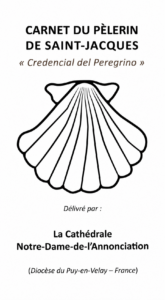
The pilgrim’s credential is a bit like a passport. It’s an official booklet where, at each stage of your journey, you can get your accommodation stamped or obtain one from the tourist office, town hall, some shops, pilgrim hostels, or even churches. This booklet will thus become a precious souvenir of your pilgrimage.
In Spain, the credential is essential: it allows access to certain hostels, provides pilgrim discounts, and, most importantly, allows you to obtain the Compostela upon arrival. This document certifies the completion of the Camino, especially when undertaken for spiritual or religious reasons.
To obtain it, you must prove that you completed the route on foot, by bicycle, or even on a donkey. You are required to have two stamps affixed per day during the last 100 kilometers on foot or the last 200 kilometers by bicycle. The Aumont Aubrac tourist office offers an official credential at a price of €10.
The gîtes d’étape (hostels) of the Aubrac region offer a warm welcome, comfort, and meals made with local produce, all in the heart of unspoiled landscapes. Often located along major hiking trails, they provide ideal stops for rest and sharing a convivial moment. During peak season (May and August), be sure to book in advance to guarantee your place.